
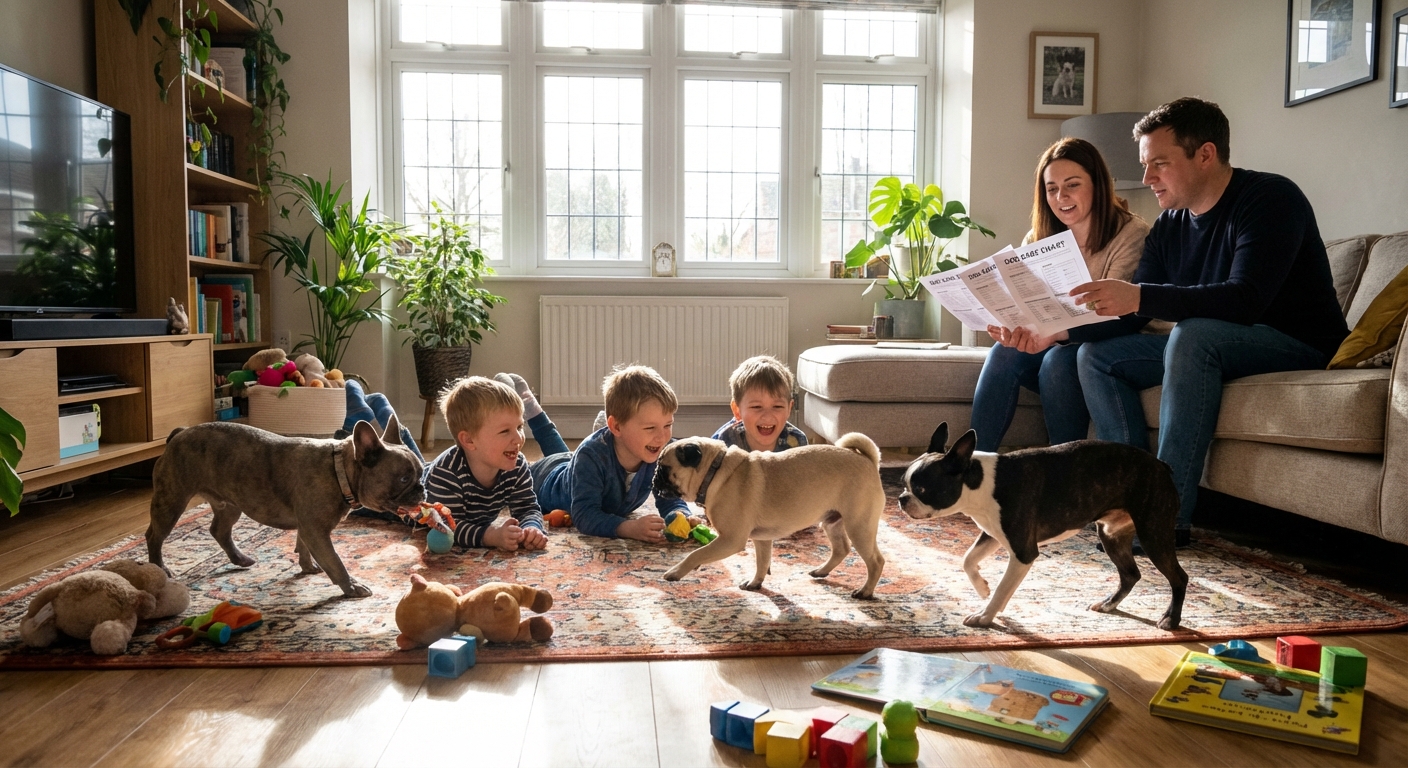
If you love big personalities in compact bodies, chances are you’ve considered a French Bulldog, Pug, or Boston Terrier. All three are charming, clownish, and wonderfully people-oriented—but they’re not interchangeable.
Introduction
This comparison breaks down their real-world health, temperament, costs, and lifestyle needs so you can pick the right small, snorty sidekick for your household.
Breed Snapshots
French Bulldog
- Size: 16–28 lbs
- Energy: Low–moderate
- Personality: Affectionate, sometimes stubborn, very people-focused
Pug
- Size: 14–18 lbs
- Energy: Moderate
- Personality: Playful, comical, social; often called a “shadow” dog
Boston Terrier
- Size: 12–25 lbs
- Energy: Moderate–high
- Personality: Lively, smart, often a bit more athletic than the other two
All three are brachycephalic (short-nosed) breeds, but they differ in health profiles, exercise tolerance, and grooming needs.
Temperament and Family Life
French Bulldog: The Laid-Back Companion
- Tends to be calm indoors and adaptable to apartment living
- Very people-oriented; often bonds deeply with one or two people
- Can be stubborn with training but responds well to food rewards
Frenchies often do well with children if socialized early and supervised appropriately. They’re usually not distance runners—think short play sessions and long couch cuddles.
Pug: The Social Butterfly
- Typically friendly with strangers, children, and other pets
- Enjoys being the center of attention; often goofy and clown-like
- Can be prone to separation distress if left alone too long
Pugs generally thrive in busy, social households that enjoy play and interaction—but they can be surprisingly sensitive to tone and harsh correction.
Boston Terrier: The Playful Athlete
- Generally more energetic and agile than Pugs or Frenchies
- Enjoys games of fetch, training, and brisk walks
- Typically eager to please and quick to learn
Bostons are often a great fit for families who want a small dog that can keep up on walks and light hikes, within reason.
Veterinary-backed tip: Individual temperament varies more by breeding and socialization than breed stereotype. Meet the parents (if possible) and ask breeders or rescues for honest temperament assessments.
Health Considerations: Breathing, Eyes, and Beyond
All three breeds face some shared health concerns, but the severity and frequency can differ.
Brachycephalic Airway Syndrome
Short-nosed breeds are prone to:
- Noisy breathing and snoring
- Exercise and heat intolerance
- Higher anesthesia risks
French Bulldogs typically have the most severe airway issues, followed by Pugs, then Bostons (who often have slightly longer muzzles).
What to look for in any of these breeds:
- Wide, open nostrils (not tightly pinched)
- Ability to walk around a room without gasping or turning blue
- Veterinarian willing to evaluate for airway surgery if needed
Other Key Health Issues
- French Bulldogs:
- Spinal problems (hemivertebrae)
- Allergies and chronic skin fold infections
- Higher than average C-section rates
- Pugs:
- Eye injuries (big, prominent eyes)
- Obesity, which worsens breathing and joint issues
- Pug Dog Encephalitis (PDE) in some lines
- Boston Terriers:
- Cataracts and other eye diseases
- Allergies and occasional breathing issues
- Some neurological and orthopedic problems
Veterinary-backed tip: Before committing, ask for:
- Health testing information (e.g., eye exams, patella checks, spine screening for Frenchies)
- A frank conversation with a vet about heat management and activity limits for brachycephalic breeds in your climate
Grooming and Everyday Care
All three have short coats—but grooming needs still differ.
Coat and Shedding
- French Bulldog: Short coat, moderate shedder, especially seasonally.
- Pug: Surprisingly heavy shedder for such a small dog; regular brushing helps.
- Boston Terrier: Typically a lighter shedder than Pugs and many Frenchies.
Skin & Wrinkles
- Frenchies and Pugs have more pronounced skin folds:
- Clean folds regularly with vet-approved wipes or solutions
- Dry thoroughly to prevent yeast and bacterial infections
- Bostons usually have fewer or shallower wrinkles, so fewer fold issues.
Product Comparison: Everyday Essentials
- Brush: Soft bristle brush or rubber grooming mitt for all three
- Skin care: Gentle, fragrance-free wipes for folds (Frenchies, Pugs)
- Harness: Front-clip harness to reduce pressure on the neck and airway
- Cooling gear: Cooling mats or vests in hot climates, especially for Frenchies and Pugs
Exercise and Training Needs
Exercise Tolerance
- French Bulldog:
- Short walks and light play; be cautious in heat or humidity
- Multiple short sessions are better than one long outing
- Pug:
- Moderate activity, but watch for overexertion
- Circuits of indoor play combined with modest outdoor walks often work well
- Boston Terrier:
- Most energetic of the three; many enjoy longer walks and interactive games
- Still brachycephalic—monitor closely in warm weather
Training Style
- All three respond best to positive reinforcement—treats, praise, and short, fun sessions.
- Pugs and Frenchies may be more stubborn; Bostons often show a bit more biddability.
- Early socialization (sounds, surfaces, strangers, calm dogs) is non-negotiable.
Real-world advice: If you want a small dog for advanced sports (like agility or scent work), a Boston is generally the strongest candidate of the three.
Cost and Lifestyle Fit
Financial Considerations
- French Bulldogs: Often the most expensive to purchase and can be costly medically due to airway, allergy, and spinal issues.
- Pugs: Moderate purchase price; budget for lifelong weight management and potential eye care.
- Boston Terriers: Often somewhat lower veterinary costs than Frenchies, though individual dogs vary.
Pet insurance is strongly recommended for all three, but especially Frenchies, given their high likelihood of needing specialized care.
Household Match
Best for small apartments:
- French Bulldog or Pug, assuming you manage stairs (many Frenchies do not excel at many flights of stairs) and heat.
- Boston Terrier, thanks to higher energy and somewhat better breathing capacity in many lines.
- Well-bred individuals of any of these breeds can be excellent, but look for:
- Calm, tolerant parents
- Breeder or rescue that prioritizes stable temperaments
- Commitment to constant supervision and teaching kids dog-safe behavior
Best for active but not extreme lifestyles:
Best with young kids:
Quick Comparison Table
| Trait | French Bulldog | Pug | Boston Terrier |
|---|---|---|---|
| Energy level | Low–moderate | Moderate | Moderate–high |
| Shedding | Moderate | High for size | Low–moderate |
| Heat tolerance | Low | Low | Low–moderate |
| Trainability | Moderate (stubborn) | Moderate (clownish) | Moderate–high |
| Sports potential | Limited | Limited–moderate (low impact) | Good for light sports |
| Vet costs (avg) | High | Moderate–high | Moderate |
Final Thoughts
French Bulldogs, Pugs, and Boston Terriers share cute snorts and big hearts, but their day-to-day care can feel very different.
- Choose a French Bulldog if you want a low-activity, people-oriented companion and are prepared for higher medical risk and costs.
- Choose a Pug if you love a social, comedic dog and can commit to careful weight management and eye/skin care.
- Choose a Boston Terrier if you’d like a compact but more athletic partner with a bit fewer breathing challenges in many lines.
Whichever snub-nosed sweetheart wins your heart, work closely with your veterinarian on weight, heat safety, and preventive care—and you’ll set your little comedian up for the healthiest, happiest life possible.