
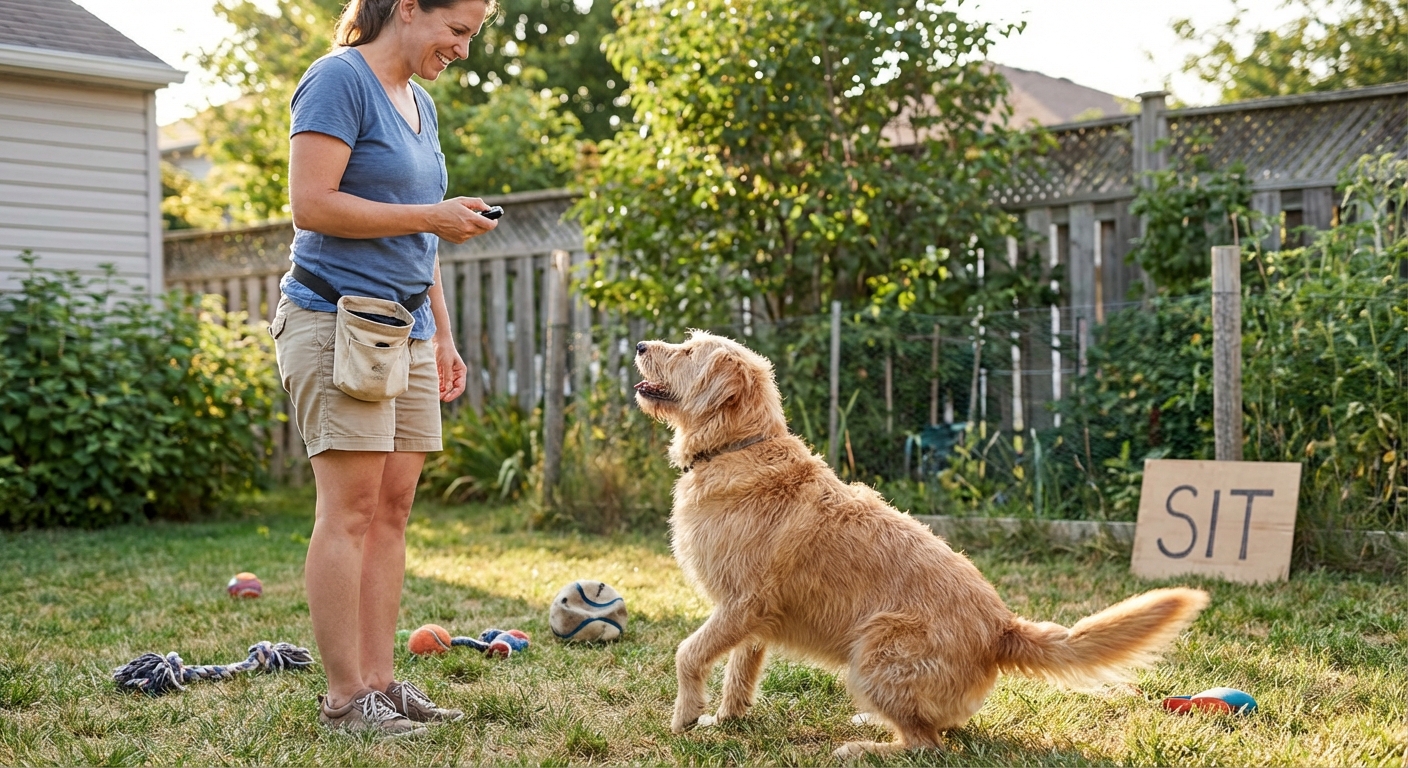
Positive reinforcement isn’t about letting your dog “get away with everything.” It’s about using clear communication and rewards to build the behaviors you want—based on how dogs actually learn.
What Positive Reinforcement Really Means
In training terms:
- Positive = you add something (like a treat or toy)
- Reinforcement = behavior becomes more likely to happen again
Modern veterinary behaviorists strongly recommend this approach because it:
- Reduces fear and stress
- Strengthens trust and the human–dog bond
- Lowers the risk of aggression compared to punishment-based methods
Let’s turn the theory into something you can use every day.
Step 1: Your Marker Word or Clicker
A marker tells your dog: “That! What you just did—yes, that’s what earns the reward.”
You can use:
- A clicker (a small device that makes a sharp click)
- A consistent word like “Yes!” or “Good!”
Charging the Marker
- Say your marker word or click.
- Immediately give a treat.
- Repeat 10–20 times.
Your dog doesn’t have to do anything yet. You’re just teaching: marker = food is coming.
Step 2: The Reward Menu (Breed and Individual Preferences)
Different dogs have different paychecks.
Food Rewards
- Soft treats (chicken, cheese, commercial training treats)
- Kibble for easy tasks in low-distraction settings
Sensitive stomachs: Ask your vet about suitable options or use part of your dog’s regular diet.
Toy and Play Rewards
- Herding and working breeds (Border Collies, Malinois, Aussies) often thrive with tug toys or balls.
- Terriers might love chasing a flirt pole.
Life Rewards
- Sniffing a tree
- Greeting a friend
- Getting on the couch (when invited)
Use better rewards for harder tasks (like recall around other dogs).
Step 3: The 3 Pillars of Positive Training
- Reinforce what you like. Catch your dog being good—lying calmly, choosing to look at you, walking by a distraction—and pay them.
- Prevent what you don’t like. Use baby gates, leashes, crates, and supervision so your dog can’t rehearse unwanted behaviors.
- Replace, don’t just stop. Every “no” should come with a “do this instead.”
Example: Instead of “No jumping,” teach “Sit” and reward that heavily when people arrive.
Step 4: Teaching a New Behavior, Step by Step
Let’s use “go to mat” as an example. This is great for excitable breeds like Labs and Doodles.
Phase 1: Lure
- Place a mat or bed on the floor.
- Lure your dog onto it with a treat.
- When all four paws are on the mat, mark and treat.
- Toss a reset treat off the mat and repeat.
Phase 2: Add Duration
- Once your dog goes to the mat easily, wait 1–2 seconds before marking.
- Gradually increase the time on the mat before the reward.
- Occasionally give a “jackpot” (several treats in a row) for longer stays.
Phase 3: Add the Cue
- Say “Place” or “Mat” before you lure.
- Soon, your dog will start going to the mat on the cue alone.
This same structure works for sit, down, spin, paw, and more.
Step 5: Reinforcement Schedules (When to Treat and When to Fade)
You don’t have to treat forever for every single sit.
Early Learning
- Reward every correct response.
- Keep sessions short and fun.
Building Reliability
- Switch to variable rewards: treat some sits, praise or play for others.
- Still pay generously for challenging environments.
Life-Long Maintenance
- Use real-world rewards: access to sniffing, playing, getting on the couch.
- Occasionally surprise your dog with a bonus treat for great choices.
Think of treats not as bribes, but as paychecks for work performed.
Breed-Specific Nuances in Positive Training
Independent Breeds (Shiba Inu, Afghan Hound, Basenji)
- Often less excited about pure obedience reps.
- Make sessions short and engaging.
- Use high-value rewards and games; avoid drilling.
Sensitive Breeds (Whippets, Collies, many rescue dogs)
- Shut down easily if frustrated or confused.
- Break tasks into tiny steps; keep criteria low.
- Use a soft voice and avoid physical pressure.
Food-Motivated All-Stars (Beagles, Pugs, Labs)
- Watch calorie intake—use low-cal treats or portion from daily food.
- Use snuffle mats and puzzle toys to let them “work” for food in healthy ways.
Common Problems and How Positive Methods Solve Them
Jumping on Guests
Instead of:
- Kneeing the dog
- Yelling or pushing them off
Do this:
- Put your dog on a leash before guests arrive.
- Ask for a sit as the guest comes in.
- Mark and treat for any attempt at sitting or keeping four paws on the floor.
- If they jump, guest turns away, conversation and treats stop.
Outcome: Dog learns that calm behavior gets attention; jumping makes the fun disappear.
Counter Surfing
Instead of:
- Swatting, shouting “No,” or using shock mats
Do this:
- Manage: Keep counters clear; use baby gates.
- Teach “on your bed” or “place” during food prep.
- Reward heavily for staying on the mat while food is on counters.
Leash Reactivity
For dogs who bark and lunge at others on walks, positive methods focus on changing the emotional response.
- At first sign of another dog, create distance.
- When your dog notices the other dog but isn’t exploding, mark and feed.
- The trigger begins to predict good things.
For moderate to severe cases, work with a veterinary behaviorist or certified positive trainer.
Tools That Pair Well with Positive Methods
- Clicker: Precise timing for marking.
- Treat pouch: Keeps rewards handy; you pay faster.
- Long line (15–30 ft): Great for practicing recall while staying safe.
- Food puzzles: Mental stimulation between sessions.
Avoid tools that rely on pain, fear, or startle: shock collars, prong collars, choke chains, air horns. They may stop behavior in the moment but can create unpredictable fallout, especially for sensitive breeds.
How to Tell if Your Training Is Working
Signs you’re on the right track:
- Your dog is eager when you pick up the leash or treats.
- They offer behaviors you’ve reinforced before, even without cues.
- They recover quickly from mistakes and stay engaged.
If your dog is shutting down, avoiding you, or showing stress signals (lip licking, yawning, turning away), reduce the difficulty and increase your rewards.
Positive Training Is for Real Life, Not Just Tricks
You can use this approach to:
- Teach grooming and vet-care handling
- Help fearful dogs feel safer
- Build focus for dog sports like agility or rally
The method stays the same: mark the behavior you like, reinforce it generously, and make good choices easier than bad ones.
Over time, you’ll see more than just trick performance. You’ll see a dog who trusts you, tries new things, and looks to you for guidance when the world feels big and loud. That’s the real magic of positive reinforcement.