
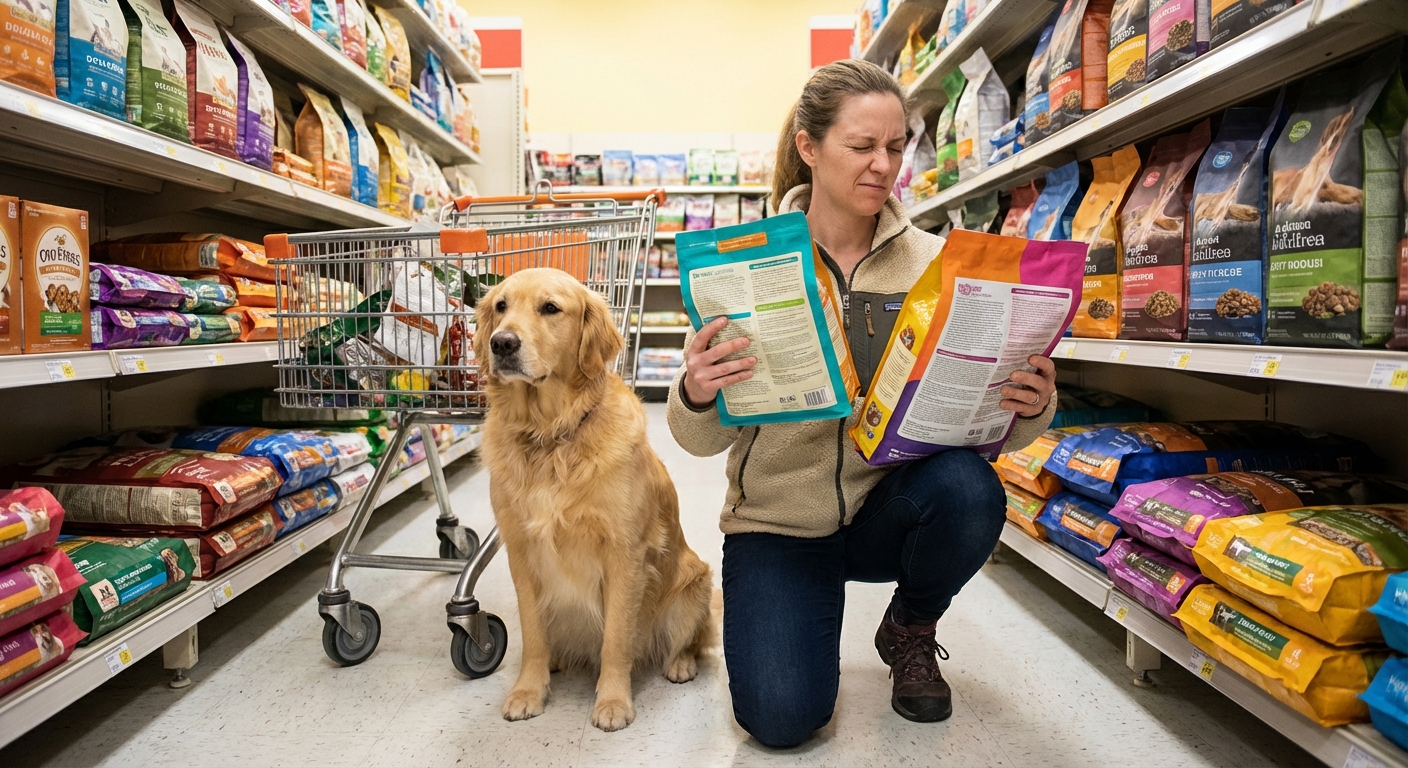
Dog food commercials are polished; labels are regulated. If you want to spot the best pet foods, the most powerful skill you can develop is reading labels with a calm, skeptical eye.
Why Reading the Label Matters More Than the Commercial
This guide walks you through every key part of a dog food label so you can choose with confidence.
Step 1: The Product Name – Sneaky but Telling
The exact wording of the product name is regulated in many regions.
Here’s what the wording often implies:
- “Chicken Dog Food” – At least ~70% chicken (including water) in many jurisdictions
- “Chicken Dinner / Entrée / Recipe / Formula” – Typically ~25% chicken
- “With Chicken” – As little as ~3% chicken
- “Chicken Flavor” – Minimal actual chicken, just enough to taste
Takeaway: The more qualifiers (dinner, with, flavor), the less of that named ingredient you’re getting.
Step 2: AAFCO Statement – Your Non-Negotiable Line
Find the nutritional adequacy statement:
“[Product] is formulated to meet the nutritional levels established by the AAFCO Dog Food Nutrient Profiles for [life stage].”
or
“Animal feeding tests using AAFCO procedures substantiate that [product] provides complete and balanced nutrition for [life stage].”
What you want:
- Complete and balanced for growth, adult maintenance, or all life stages
- Either formulated to meet or proven by feeding trials (feeding trials provide stronger evidence)
Avoid using foods labeled as “intermittent or supplemental feeding only” as your dog’s main diet.
Step 3: Ingredients List – Useful, But Don’t Obsess
Ingredients are listed by weight before cooking.
What to feel good about
- Named animal proteins like chicken, turkey, beef, salmon
- Whole grains and complex carbs like oats, barley, brown rice, sweet potato
- Named fats such as chicken fat, salmon oil, sunflower oil
- Added vitamins and minerals toward the end (normal and necessary)
What to interpret carefully
- Meat meal (e.g., chicken meal): a concentrated, cooked and dried protein source. Can be excellent when species is named and quality is controlled.
- By-products: organs and parts not usually eaten by humans. Poultry by-product meal from reputable brands can be nutritious, but vague terms like “meat by-product” without species are a yellow flag.
What to question
- Multiple artificial colors (dogs don’t need colored kibble)
- Long lists of sweeteners or flavor enhancers
- Ingredients like “animal digest” without named species
Key reality: A pretty ingredient list doesn’t guarantee digestibility or balance. Brand research and formulation expertise matter just as much.
Step 4: Guaranteed Analysis – Crude Numbers, Real Clues
The guaranteed analysis lists minimums and maximums for key nutrients:
- Crude protein
- Crude fat
- Crude fiber (max)
- Moisture (max)
Additional nutrients (e.g., omega-3, calcium, phosphorus) may also be listed.
How to actually use it
- Compare protein and fat levels between similar foods (e.g., two adult kibbles) on a dry matter basis if moisture differs significantly.
- Watch calcium and phosphorus levels for large-breed puppies.
- Very high fiber can mean fewer calories per cup; helpful for weight loss but not for every dog.
For a quick energy check: Foods marketed as weight management tend to be lower in fat and calories per cup. High-performance foods are the opposite.
Step 5: Life Stage and Size – Make Sure It Fits Your Dog
Look for phrases like:
- Puppy / Growth
- Adult Maintenance
- All Life Stages
- Senior (not an official AAFCO category, but a marketing term)
And sometimes:
- Small Breed
- Large Breed
Practical guidance:
- Puppies, pregnant, and nursing dogs need growth or all life stages.
- Large and giant breed puppies should get large-breed puppy formulas.
- Small breeds often do best on small-bite kibble with appropriate calorie density.
Step 6: Brand Transparency – The Part You Can’t See on the Bag
Some of the most important quality signals are off-label:
Ask or look on the brand’s site for:
Do they employ a full-time board-certified veterinary nutritionist (DACVN)?
Do they conduct and publish feeding trials?
Where is the food manufactured – their own facility or a third-party plant?
What’s their recall history, and how do they communicate about it?
Brands that score well on these answers are much more likely to produce consistently high-quality foods.
Step 7: Calorie Content – The Secret to Weight Control
Look for a line such as:
Metabolizable energy (ME): 3,600 kcal/kg, 400 kcal/cup.
How to use this
- If your dog is gaining weight, a food with fewer calories per cup may help.
- If your dog is underweight or very active, a more caloric diet might be necessary.
Combine this with your vet’s estimate of your dog’s daily calorie needs, then adjust based on body condition over 2–4 weeks.
Step 8: Marketing Claims – How to Stay Skeptical
Common claims and how to interpret them:
- “All-natural” – Minimally regulated term; doesn’t guarantee nutritional balance.
- “Holistic” – Essentially marketing; no legal nutritional definition.
- “Human-grade” – More strictly defined; every ingredient and the manufacturing process must be edible for humans. Good hygiene indicator, but not a guarantee of better nutrition.
- “Grain-free” – Necessary only for specific medical reasons. Most dogs tolerate grains well, and some grain-free diets have been associated (in certain circumstances) with DCM.
Rule of thumb: If the bag shouts more about philosophy than about science and safety, ask more questions.
Real-World Label Reading Examples
Example 1: Large-Breed Puppy
You see:
- Name: “Chicken and Rice Large Breed Puppy Food”
- AAFCO: Complete and balanced for growth, including large-size dogs
- First ingredients: Deboned chicken, chicken meal, brown rice, barley
- Extras: Listed calcium and phosphorus within large-breed puppy range
This checks many boxes for a growing Lab, Golden, or GSD puppy.
Example 2: Generic Adult Food with Vague Ingredients
You see:
- Name: “Premium Meat Dinner Dog Food”
- AAFCO: Complete and balanced for all life stages
- First ingredients: Corn, meat by-product, animal fat, wheat middlings
- Meat is non-specific, no info about by-product source
This isn’t automatically unsafe, but the lack of specificity and reliance on vague terms makes it harder to judge quality.
Final 10-Second Label Checklist
- [ ] AAFCO complete and balanced for my dog’s life stage
- [ ] Named animal protein source near the top
- [ ] Appropriate size/breed/lifestyle labeling
- [ ] Transparent brand with nutrition expertise and feeding trials
- [ ] Calorie information available and reasonable for my needs
- [ ] My dog maintains a healthy weight, coat, and energy on it
When you can confidently answer those points from the label (and a quick look at the brand’s background), you’re well on your way to choosing one of the best pet foods for your dog—without being swayed by marketing alone.